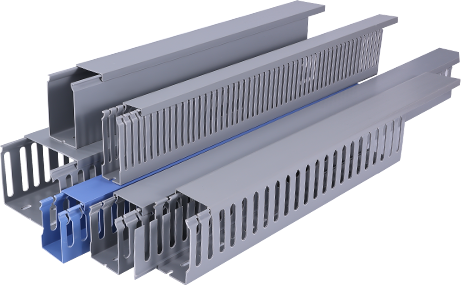

In today's rapidly evolving technological landscape, the demand for efficient and organized electrical systems has never been higher. From industrial facilities to commercial buildings and residential spaces, managing the ever-increasing number of cables and wires is a constant challenge. This is where large capacity wiring duct comes into play, offering a robust solution for organizing, protecting, and managing extensive wiring systems.
Large capacity wiring duct, also known as cable duct or wire raceway, is a specialized channel designed to house and route multiple cables and wires. Unlike traditional smaller duct systems, these large capacity variants are engineered to accommodate a significantly higher volume of cables, making them ideal for projects with complex wiring requirements. They are typically constructed from durable materials such as PVC, metal, or fiberglass, each offering distinct advantages depending on the application.
One of the key benefits of large capacity wiring duct is its ability to streamline cable management. In environments where dozens or even hundreds of cables need to be routed, these ducts provide a structured pathway that prevents tangling and simplifies maintenance. Electricians and technicians can easily access individual cables without disrupting the entire system, reducing downtime and improving efficiency. This organized approach also enhances safety by minimizing the risk of accidental disconnections or short circuits caused by tangled wires.
Another advantage of large capacity wiring duct is its versatility. These ducts come in various shapes, sizes, and configurations to suit different applications. Some feature snap-on lids for easy access, while others have hinged covers that allow for quick inspection. Additionally, they can be mounted on walls, ceilings, or floors, providing flexibility in installation. This adaptability makes them suitable for a wide range of settings, from data centers and server rooms to manufacturing plants and office buildings.
Durability is another critical factor that sets large capacity wiring duct apart. High-quality materials ensure that these ducts can withstand harsh environmental conditions, including extreme temperatures, moisture, and physical impact. For example, metal wiring ducts offer excellent protection against fire and mechanical damage, making them ideal for industrial environments. PVC ducts, on the other hand, are lightweight and corrosion-resistant, making them suitable for indoor applications where weight is a concern.
In industrial settings, large capacity wiring duct plays a crucial role in maintaining operational efficiency. Manufacturing plants, for instance, rely on a vast network of cables to power machinery, control systems, and sensors. Without proper organization, these cables can become a safety hazard and hinder productivity. Large capacity ducts provide a secure pathway for these cables, ensuring they remain protected from dust, debris, and accidental damage. This not only extends the lifespan of the cables but also reduces the need for frequent replacements, resulting in cost savings over time.
In commercial buildings, such as offices and retail spaces, large capacity wiring duct helps create a clean and professional appearance. Exposed cables can be unsightly and give a cluttered impression, which is particularly important in customer-facing environments. By concealing cables within these ducts, businesses can maintain a polished aesthetic while ensuring the reliability of their electrical systems. This is especially beneficial in open-plan offices where multiple workstations require power and data connections.
Residential applications also benefit from large capacity wiring duct. With the increasing number of smart home devices, entertainment systems, and home office setups, homeowners are faced with managing a growing number of cables. Large capacity ducts can be installed in basements, attics, or behind walls to route cables from the main panel to various rooms, keeping living spaces tidy and reducing the risk of tripping hazards. They also simplify future upgrades, allowing homeowners to add new cables without major renovations.
When selecting a large capacity wiring duct, several factors should be considered. The material choice is crucial, as it affects durability, fire resistance, and cost. PVC ducts are affordable and easy to install, making them suitable for most indoor applications. Metal ducts, such as steel or aluminum, offer superior strength and fire resistance, making them ideal for industrial or high-temperature environments. Fiberglass ducts, on the other hand, are lightweight and corrosion-resistant, making them suitable for outdoor or humid conditions.
The size of the duct is another important consideration. Large capacity ducts are available in various widths and heights, ranging from a few inches to several feet. The choice depends on the number and size of cables that need to be accommodated. It is essential to calculate the total volume of cables, including their insulation, to ensure the duct can handle the load without overcrowding. Overcrowding can lead to overheating and reduced airflow, which may compromise the performance and safety of the electrical system.
Installation of large capacity wiring duct requires careful planning and execution. Proper measurement and layout are essential to ensure the ducts are positioned correctly and provide optimal cable routing. Mounting brackets or adhesive tapes are commonly used to secure the ducts, depending on the surface and weight requirements. It is also important to leave sufficient space for future expansions, as electrical systems often need to be upgraded or modified over time.
In conclusion, large capacity wiring duct is an indispensable component of modern electrical systems. Its ability to organize, protect, and manage extensive wiring makes it a cost-effective solution for a wide range of applications. Whether in industrial facilities, commercial buildings, or residential spaces, these ducts enhance efficiency, improve safety, and simplify maintenance. As technology continues to advance and the demand for complex wiring systems grows, the importance of large capacity wiring duct will only increase. By investing in high-quality duct systems, businesses and homeowners can ensure their electrical systems remain organized, reliable, and future-proof.